Mental Health & Work-Life Balance Counselling
Counselling provides a structured, confidential space to help you make sense of challenges and move forward with clarity.
Sessions are focused and time-limited (typically 6–18 sessions), with clear goals and regular review of progress.
Through this process, you will:
- identify the root causes of ongoing difficulties
- review how you are currently coping
- understand patterns affecting your wellbeing
- develop healthier, more effective strategies
- create a work-life balance plan that works for you
Work-Life Balance Planning
Not generic advice.
We help you create a plan that:
- fits your real life
- reduces pressure
- improves wellbeing
- is sustainable long-term
Individual Sessions
Person-to-person counselling offers a dedicated space for individuals to reflect on personal, relational, and professional challenges arising in culturally diverse or transitional contexts.
These sessions are grounded in schema-informed counselling principles and an Adlerian understanding of meaning, belonging, and responsibility. The focus is on recognising recurring patterns of interpretation and response that influence relationships, emotional reactions, and decision-making — particularly in situations involving change, difference, or heightened expectations.
Person-to-person counselling can support reflection around:
- interpersonal and intercultural relationship challenges
- adjustment during periods of transition or change
- persistent stress, uncertainty, or emotional pressure
- recurring relational patterns affecting wellbeing and functioning
Sessions are conducted through structured, collaborative dialogue, supporting clients to explore attitudes, expectations, and behaviours within their cultural and social context. The aim is not treatment or diagnosis, but increased awareness, personal responsibility, and constructive adjustment.
The counselling process typically involves a minimum of six weekly sessions, allowing sufficient time for reflection, integration, and review of progress.
View Rates
Rates for Personal/Individual Counselling
Online or in-person sessions:
(One-on-one as well as for Group/Team sessions)
45 minutes: € 50.00 (excl VAT) – per session
60 minutes: € 75.00 (excl VAT) – per session
Bundle Pack: € 255.00 (excl VAT) – 6 sessions of 45 minutes per session (15% reduction)
Workplace Counselling
for organisations working with diverse workforces
Workplace and corporate counselling supports organisations, leaders, and employee wellbeing, navigating the relational and cultural complexity of contemporary working environments. In an increasingly globalised context, marked by rapid technological change, economic uncertainty, and diverse teams, individuals and organisations are often required to adapt quickly while maintaining performance and professional relationships.
Our workplace counselling services are schema-informed and grounded in an Adlerian intercultural perspective, recognising that workplace challenges are shaped by patterns of expectation, belonging, authority, and responsibility within specific organisational and cultural contexts.
Workplace counselling can support employees and organisations in addressing challenges related to:
- work performance and role clarity
- increased absenteeism or disengagement
- strained relationships with colleagues or leadership
- cultural adjustment for international or relocated staff
Our approach combines reflective counselling with contextual and organisational analysis, allowing challenges to be understood within the wider system rather than in isolation.
Intercultural workplace counselling services may involve:
- on-site or contextual analysis of the current situation
- collaborative exploration of organisational and cultural factors
- assessment of leadership and team dynamics
- identification of relational or structural blockers
- structured stressor analysis and adjustment strategies
This work supports clarity, responsibility, and adaptive functioning, helping organisations and individuals respond constructively to complexity while respecting professional roles, boundaries, and organisational realities.
View Rates
Rates for Corporate/Workplace Intercultural Counselling Online or in-person sessions:
(One-on-one as well as for Group/Team sessions)
45 minutes: € 75.00 (excl VAT) per session
60 minutes: € 100.00 (excl VAT) per session
Bundle Pack: € 405 (excl VAT) – 6 sessions of 45 minutes per session (15% reduction)
Bundle Pack: € 720 (excl VAT) – 12 sessions of 45 minutes per session (20% reduction)
Individual Sessions
Workplace & Corporate Counselling
What Does it Mean to Be Overwhelmed: Interview With Maria-Gabriele Doublesin
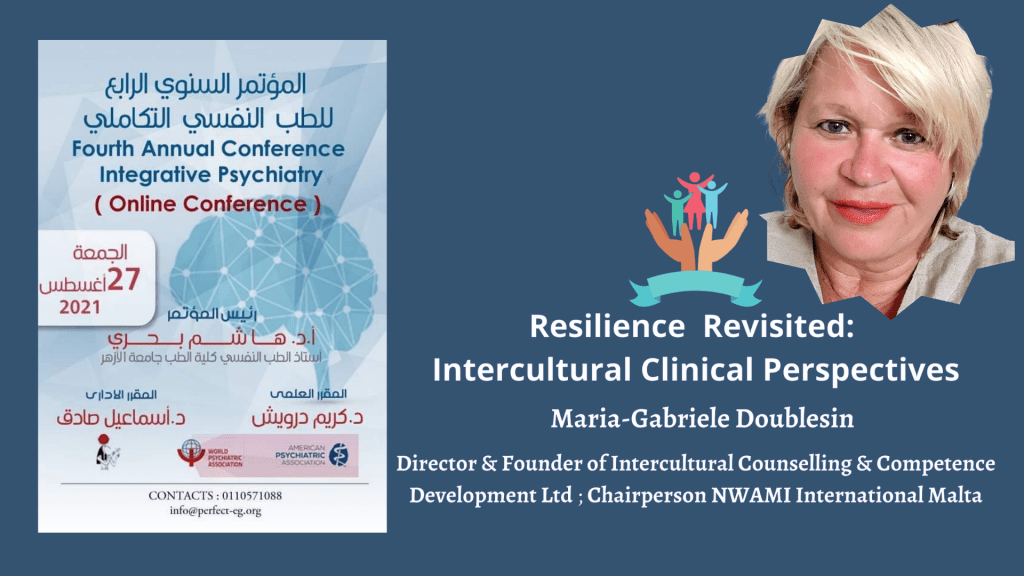
What sets Maria-Gabriele Doublesin apart as a professional is her wealth of experience and recognition within the field. As a testament to her expertise, she has been repeatedly invited to share her knowledge at the prestigious Annual Al Azhar Conference of Integrative Psychiatry, a gathering jointly organized by the World Psychiatric Association. This notable distinction underscores the significance of her contributions to the intersection of culture and mental health.
Acknowledging the dynamic nature of resilience, Doublesin explores in this presentation nuances that significantly impact how individuals navigate their psychological and emotional landscapes. Her insightful examination sheds light on the intercultural clinical practice, emphasizing the importance of understanding and integrating culture-related resilience factors.